
Our Guide & Resources

Spain Made Understandable for Americans
Understand how Spain’s NIE, Digital Nomad residence, and tax systems actually connect — before you land in Madrid.
What’s Inside the Spain Essentials Guide
A structured breakdown of how Spain’s identification, residency, and tax systems connect — so you can make informed decisions before landing in Madrid.
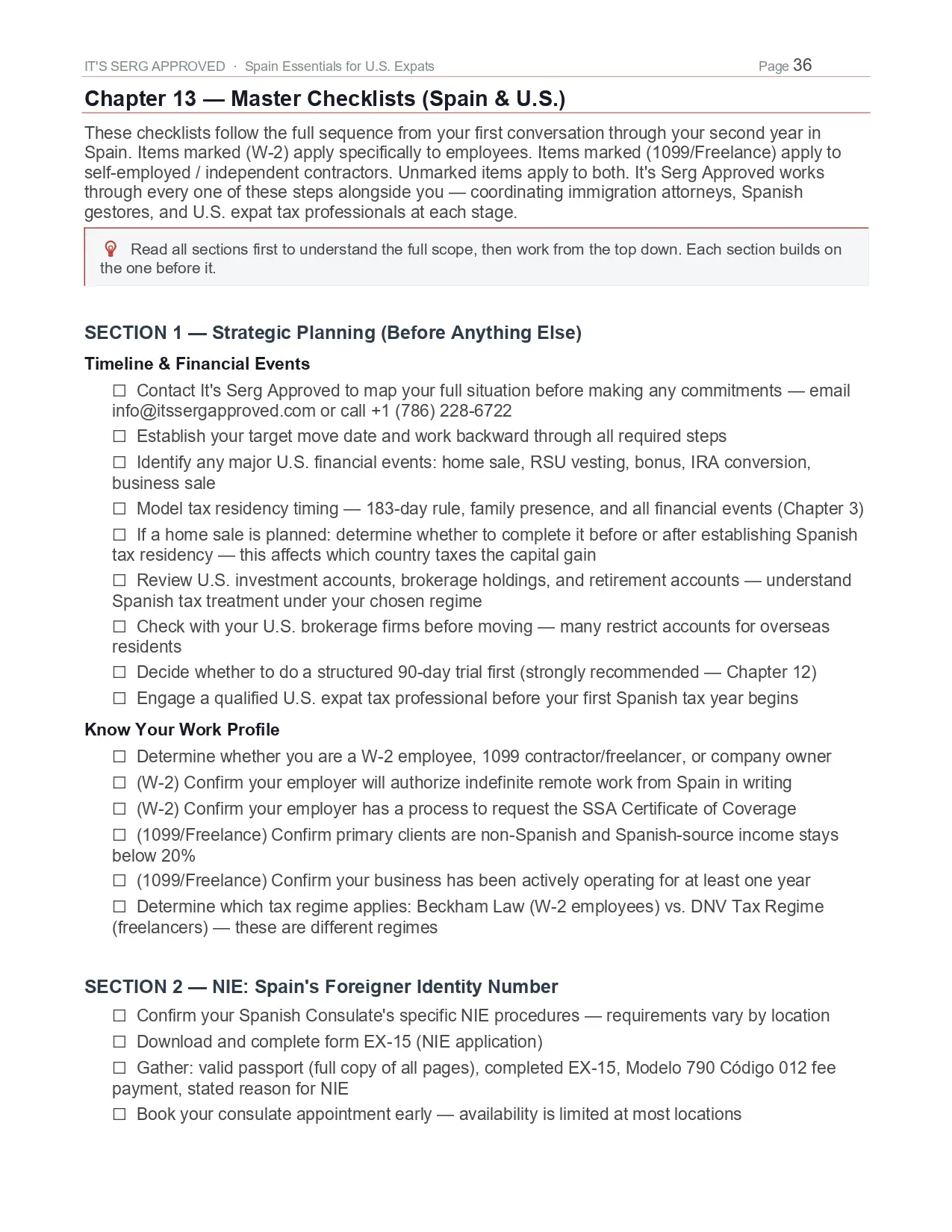
- Clarifies the difference between NIE and legal residency
- Explains how Digital Nomad residence actually works
- Breaks down Beckham Law considerations
- Connects Spain’s tax system with ongoing U.S. tax obligations
Spain Made Understandable for Americans: Tax Residency, NIE, Digital Nomad Visas, Autónomos, Beckham Law & U.S. Taxes (Including FBAR & FATCA)
Thinking about living and working from Spain? This page explains, in plain English, how Spanish tax residency, your NIE, Digital Nomad / telework residence, autónomo rules, Spain’s “Beckham Law,” and your U.S. tax and reporting obligations (including FBAR and FATCA) fit together—so you can move confidently instead of guessing.
Created by an American family who actually moved from North Carolina to Madrid—six suitcases, two kids, and a lot of paperwork.
How All the Pieces Fit Together
When you’re an American planning a move to Spain, you’re not just dealing with “a visa.” You’re navigating several overlapping systems:
- Spanish tax residency – when Spain considers you a tax resident (183 days, kids in school, center of interests) and can tax your worldwide income.
- NIE – your foreigner identification number in Spain (like an ID number for non-citizens).
- Digital Nomad / international telework residence – your legal right to live in Spain while working remotely for foreign employers or clients, as well as whether you’re taxed as a W2 employee, a standard resident (autónomo) or under Beckham Law.
- U.S. tax & reporting – tools like Form 1116 (Foreign Tax Credit), Form 2555 (Foreign Earned Income Exclusion), and FBAR / FinCEN Form 114 and FATCA / Form 8938 for foreign accounts and assets, so you don’t get taxed twice or miss reporting obligations.
A smart plan usually looks like this:
Step 1: Understand Spanish tax residency & timing (183 days, family ties) →
Step 2: Identity (NIE) →
Step 3: Residence track (Digital Nomad / telework or other visa) →
Step 4: Tax route in Spain (standard resident / autónomo vs. Beckham Law) →
Step 5: U.S. tax + FBAR / FATCA coordination.
Example: “Tab Overload” in the U.S.
Sarah, a UX designer in Austin, wants to move to Madrid for at least a year. She opens 20 browser tabs: NIE info, Digital Nomad Visa threads, Facebook groups, Spanish tax blogs, IRS pages, and random Reddit comments. Everything contradicts everything else. This page is meant to be the clear, big-picture map Sarah wishes she had before diving into forms and appointments.
Step 1: Spanish Tax Residency – 183 Days, Kids in School & Timing
Before you think about visas or tax regimes, you need to understand when Spain treats you as a tax resident. Spanish tax residency is usually decided by three main tests in a calendar year:
- You spend more than 183 days in Spain (days do not need to be consecutive).
- Your main economic interests (work, business, income center) are in Spain.
- Your spouse (not legally separated) and minor children habitually live in Spain. In this case, the law presumes you are tax resident in Spain unless you can prove tax residency in another country.
If Spain considers you a tax resident for a given year, you are generally taxed on your worldwide income for the entire calendar year (January 1 to December 31), subject to tax treaty rules.
Tourist Days Count Toward 183 Days
The 90-day Schengen rule is an immigration rule. The 183-day rule is a tax rule. From a tax perspective, Spain cares about physical presence, not your visa label. That means days spent in Spain as a tourist still count toward the 183-day total for tax residency.
Kids in School and Family Life
If your kids are enrolled in school in Spain and living there most of the year, that’s strong evidence that your family’s center of life is in Spain. Combined with your spouse being there, authorities may presume you are also a Spanish tax resident, even if you personally try to stay under 183 days on paper.
The “Move After July 2” Timing Idea
Some people plan to move to Spain on or after July 2 because there are exactly 183 days between July 2 and December 31. The logic: if you arrive then and don’t meet the economic or family tests, you may avoid being a Spanish tax resident for that year and keep major events earlier in the year (like selling a home abroad) outside Spanish worldwide taxation.
But this is a planning concept, not a legal guarantee. If your spouse and kids are already living in Spain, or your main work and income move here, Spain may still consider you a tax resident for the full year. High-value decisions like selling real estate or timing your move should always be checked with a qualified Spanish tax advisor and a U.S. expat tax professional.
Example: Selling a U.S. Home
A couple in North Carolina sells their primary home in March, then moves to Madrid in late August with a Digital Nomad residence. They try to stay under 184 days and keep their economic ties in the U.S. for that year. With proper planning and professional advice, they may be treated as non-residents for that calendar year in Spain, so the U.S. home sale is taxed under U.S. rules only. The following year, when they meet the 183-day and family tests, they become Spanish tax residents and adjust accordingly.
Step 2: Your NIE – Spain’s Foreigner Identity Number
The NIE (Número de Identidad de Extranjero) is your personal ID number in Spain as a foreigner. You’ll see it requested everywhere. You typically need a NIE to:
- Rent an apartment or sign a long-term lease.
- Open a Spanish bank account.
- Set up utilities, internet, or a mobile phone plan.
- Buy property or a car.
- Register with Spanish tax authorities and appear correctly on official forms.
- Support visa and residence applications.
A NIE is not a visa and not a residence permit. Think of it as your Spanish “file number” that offices, banks, and agencies use to identify you.
How and Where You Can Get a NIE
You can usually apply for a NIE:
- In Spain – through an immigration office or designated police station.
- From abroad – at the Spanish Consulate that corresponds to where you live.
Typical NIE requirements include:
- Filling out the official EX-15 form (NIE application).
- Presenting your valid passport and copies.
- Stating the economic, professional, or social reason you need a NIE (buying property, preparing for residence, work, etc.).
- Paying the NIE fee using the appropriate Spanish payment form.
- Providing proof of residence in the consular district if applying abroad.
Once assigned, your NIE stays with you. It identifies you to Spanish administrations, but it does not, on its own, give you the right to live in Spain long term.
Example: “The Property Before the Visa”
A couple from Chicago finds their dream apartment in Madrid and wants to buy before starting the long-term visa process. The Spanish notary, bank, and tax authorities all require them to have NIEs. They apply for NIEs through the Spanish Consulate for their state, get their numbers, and later those same NIEs are used for their Digital Nomad residence and tax registration.
Step 3: Digital Nomad / International Telework Residence
Spain’s international telework framework (the Digital Nomad Visa route) lets certain non-EU citizens live in Spain as residents while working remotely for foreign employers or clients.
This route generally fits:
- W-2 employee of a U.S.-based company or non-Spanish company.
- 1099 / self-employed freelancers with foreign clients.
- Owners of a foreign-registered company who work remotely for their own business.
Core Eligibility (Simplified)
You typically need to show that:
- You are a non-EU citizen (for example, a U.S. citizen).
- You have a real, ongoing remote job or professional activity tied to foreign entities or clients.
- The foreign company or business has been active for at least one year.
- Your work is genuinely remote, done through digital tools.
- You meet Spain’s minimum income requirements for yourself and any dependents (based on multiples of the Spanish minimum wage / SMI).
- You have clean criminal record checks and private health insurance valid in Spain.
- You meet Social Security rules—either under the Spanish system (RETA) or via the U.S.–Spain Totalization Agreement.
- Typically, no more than about 20% of your total income comes from Spanish clients or companies.
W-2 Employees: Extra Requirements
If you’re a U.S. W-2 employee, your Digital Nomad application path includes extra pieces:
- An Employer Authorization Letter explicitly allowing you to work remotely from Spain on an indefinite basis, on company letterhead, signed.
- Proof of employment: contract, recent pay stubs, and often your latest W-2.
- An SSA Certificate of Coverage requested by your employer from the U.S. Social Security Administration, proving you remain under U.S. Social Security (under the Totalization Agreement).
- An apostille on the SSA Certificate for use in Spain.
These steps protect you from paying into both U.S. and Spanish Social Security at the same time and are often the slowest part of the process—something to start early.
Self-Employed / 1099 Contractors
If you’re a freelancer or independent contractor, your application is built around:
- Proof your business has been active for at least a year (LLC documents, EIN, prior tax returns).
- Client contracts or letters showing foreign clients and remote work.
- Proof of income (invoices, bank statements, tax returns) above the required thresholds.
- Criminal records, health insurance, and accommodation documentation similar to W-2 applicants.
Where to Apply: Consulate vs. Inside Spain
You generally have two application paths:
- From the U.S. (Spanish Consulate) – You apply at the consulate for your state, receive a 1-year national visa, then convert it to a longer TIE residence card after arriving in Spain.
- From inside Spain (UGE-CE) – If you are already legally in Spain as a tourist and within your 90 days, you may apply online through the centralized UGE-CE unit and, if approved, receive a 3-year residence authorization directly.
Example: “Remote Engineer from Seattle”
Alex is a software engineer with a U.S. W-2 job that’s already remote. Her employer agrees in writing that she can work indefinitely from Spain and requests an SSA Certificate of Coverage on her behalf. She applies for the Digital Nomad Visa via her Spanish Consulate, moves to Madrid, gets her TIE, and then evaluates whether Beckham Law makes sense given her income and U.S. investments.
Digital Nomad as Self-Employed – Standard Autónomo Route
Many American Digital Nomad residents aren’t “employees” in the W-2 sense—they’re really 1099 contractors / freelancers. In Spain, that usually means registering as autónomo (self-employed) under the standard resident tax regime, not Beckham.
This section is for those people: self-employed Digital Nomad residents who live and work in Spain under the normal resident rules.
Becoming an Autónomo Under the Digital Nomad Route
- Register with Agencia Tributaria as autónomo, declaring your economic activity.
- Register with Spanish Social Security under the RETA (self-employed system), unless you’re covered via the Totalization Agreement in a different way.
-
Set up ongoing compliance:
- Modelo 130 – quarterly income tax prepayments (IRPF) in many cases.
- Modelo 303 – quarterly VAT (IVA) returns, if your services are subject to VAT.
- Modelo 390 – annual VAT summary for many autónomos.
- Monthly Social Security (RETA) contributions based on your real net income band (“tramo”).
Under this route, you are taxed as a normal Spanish tax resident with progressive income tax rates and business expense deductions, instead of flat Beckham rates.
Legal / Policy Disclaimer
Disclaimer:
It’s Serg Approved is an independent relocation support and lifestyle consulting service. This landing page, guide, and website content are provided for informational and educational purposes only and do not constitute legal, immigration, Social Security, or tax advice.
Official requirements, procedures, and fees for NIEs, visas, residence permits, Digital Nomad / telework applications, autónomo registrations, Social Security contributions, and Spanish tax forms such as Modelos 030, 130, 149, 150, 151, 303, and 390, as well as U.S. forms such as Forms 1116 and 2555, the FBAR (FinCEN Form 114), and FATCA Form 8938, may change and may differ according to the competent authority or consulate.
For the most current and authoritative information, always consult official Spanish and U.S. government resources, such as:
- Spanish Ministry of Inclusion, Social Security and Migration.
- Spanish Social Security (Seguridad Social) and its official RETA information and simulators.
- Spanish Tax Agency (Agencia Tributaria) for official information and forms.
- The Internal Revenue Service (IRS) for official U.S. forms and instructions.
- The website of the Spanish Consulate or Consular Office in whose district you legally reside.
For full terms, policies, and privacy details, please visit:
https://itssergapproved.com/terms-policies/